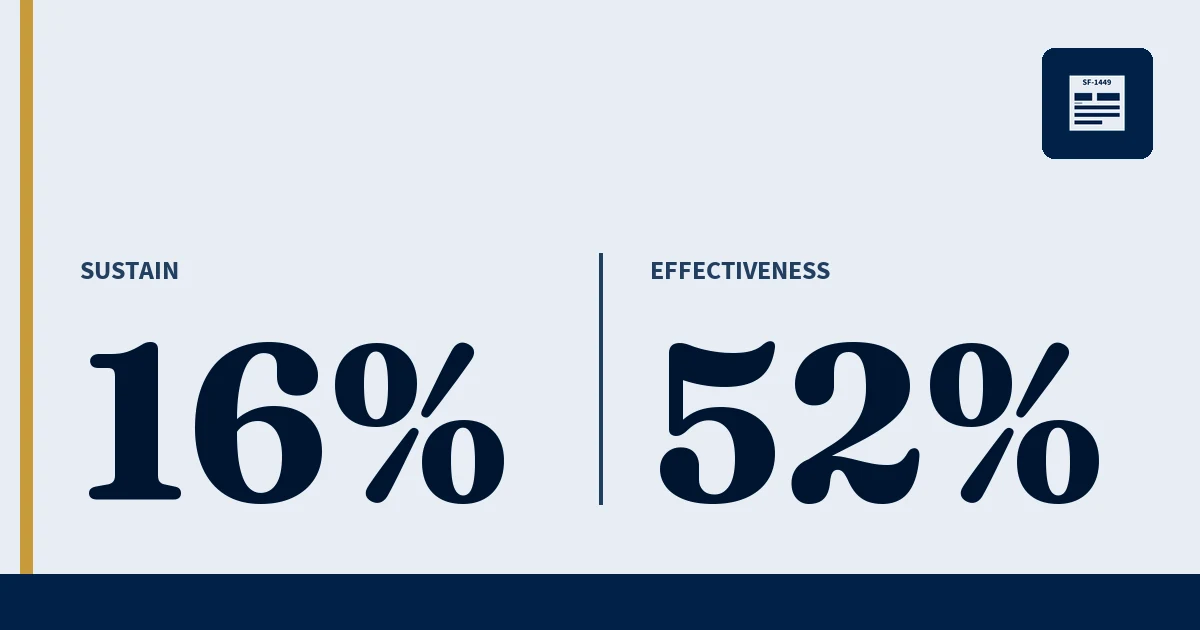
The short answer: The GAO’s 16% sustain rate measures formal rulings in your favor. The 52% effectiveness rate measures something more useful: how often protesters got actual relief, including voluntary corrective action the agency took before GAO ever issued a ruling. Most contractors quit at the wrong number.
Most contractors hear the bid protest sustain rate cited at 16% and decide protests don’t work. They are reading the wrong number.
The Government Accountability Office (GAO) publishes two bid protest statistics every year. One measures formal legal victories. The other measures practical relief. They are not the same thing, and confusing them costs contractors real money.
In its FY2024 Bid Protest Annual Report (GAO-25-900611), the GAO recorded 1,803 protest cases filed. The sustain rate was 16%. The effectiveness rate was 52%. Understanding the difference between those two figures is the first decision you need to make before filing.
What “Sustain Rate” and “Effectiveness Rate” Actually Mean
The sustain rate is the percentage of protests where GAO formally ruled in the protester’s favor after reviewing the agency record and issuing a written decision. A sustain is a legal finding that the agency made a procurement error that materially affected the award. It is the hardest outcome to achieve because GAO must complete a full review, the agency must respond with its record, you must brief the legal arguments, and GAO must find the evidence sufficient to overturn the procurement decision.
In FY2024, 16% of protests that received a merits decision were sustained. That sounds discouraging until you look at what happens before GAO reaches a merits decision.
The effectiveness rate measures a broader outcome: how often the protester received some form of relief, whether through a formal sustain or through voluntary corrective action taken by the agency before or during the GAO review. When an agency takes corrective action, it typically means the agency reviewed its own procurement, identified a problem, and agreed to recompete, reevaluate, or amend the solicitation without waiting for GAO to rule.
The GAO FY2024 report (GAO-25-900611) puts that combined rate at 52%. Meaning: in more than half of all protest cases that progressed, the protester got something. The protest worked, just not always through a formal ruling.
The $500 filing fee (effective October 1, 2024; verify current amount at gao.gov before filing) and the 100-day GAO decision clock look different once you understand that agencies often respond to a filed protest before the clock runs out.
Why Corrective Action Matters as Much as a Sustain
Voluntary corrective action is the mechanism that drives the gap between 16% and 52%. It is also the outcome most contractors do not plan for.
When you file a protest, the Competition in Contracting Act (CICA) (31 U.S.C. 3551-3557) triggers an automatic stay of contract award in most circumstances. The stay-of-award mechanism itself is at 31 U.S.C. 3553(c) and (d). The agency cannot proceed with performance while the protest is pending. That stop-work pressure is significant. Contracting officers, program managers, and agency counsel all have an interest in resolving the protest quickly so the work can start.
In response, agencies frequently review their own source selection record once a protest is filed and decide, on their own, that the evaluation had a problem worth fixing. The corrective action might be as limited as a re-evaluation of a specific factor or as broad as a full resolicitation. Either way, the protester gets a second chance at the award without ever receiving a formal sustain.
A formal sustain is rarer and carries more authority. GAO recommends a specific remedy, which can include re-evaluation, resolicitation, termination of the incumbent award, or payment of the protester’s protest costs. Agencies almost always implement GAO’s sustain recommendations: the GAO Annual Report to Congress historically describes full agency implementation as the normal outcome. Corrective action achieves most of the same practical results without requiring GAO to reach that point.
The protest is the pressure. The stay is the mechanism. Relief comes from both paths.
When a Protest Is Worth Filing: A Six-Question Filter
Not every loss is protestable. Not every protestable loss is worth the cost. Work through these six questions before deciding.
Did the Agency Violate a Procurement Rule (FAR or Agency Supplement)?
Protests succeed when they identify a specific, articulable legal violation: a Federal Acquisition Regulation (FAR) deviation, an evaluation that ignored stated criteria, a best-value tradeoff that contradicted the solicitation’s own weighting scheme, or a price evaluation that departed from the announced methodology. Disappointment with the outcome is not a ground. Identify the specific rule the agency broke before you file.
Was the Violation Material to the Award Decision?
A procurement defect that would not have changed the outcome does not support a protest. GAO will deny protests where the error was harmless. Ask: if the agency had done this correctly, would the award result have been different? If the answer is clearly no, the protest will not survive.
Do You Have Standing as an Interested Party?
GAO requires protesters to be “interested parties,” meaning you must be an actual or prospective offeror whose direct economic interest would be affected by the award (31 U.S.C. 3551(2) and 4 CFR 21.0(a)). If you did not submit a proposal, you generally cannot protest. If you would not have been in line for the award even with the correction, standing becomes contested. Confirm you are a proper party before spending time on the other questions.
Are You Within the 10-Day Filing Window from the Debrief?
This is the window most contractors miss. The two-track structure here matters, so read carefully.
For a protest filed at GAO, 4 CFR 21.2(a)(2) (the GAO Bid Protest Regulations, implemented through FAR 33.104) requires post-award protests to be filed within 10 calendar days after the basis of protest is known or should have been known. If you requested and received a required debriefing, the clock runs from the date the debriefing concludes (not from the date of award). Do not wait. Ten days is not long, and there is no exception for weekends in counting the window. Calculate the deadline the moment you receive notice of award or finish a debriefing.
For an agency-level protest, FAR 33.103 governs on a separate track with its own timing rules. Most small businesses file at GAO; agency-level protests are a separate forum with different procedures.
Will Your Protest Trigger the CICA Automatic Stay?
This is the question that separates a protest with real leverage from a protest that is merely on paper. Even when a protest is timely under the GAO regulations, the CICA automatic stay attaches only if the filing meets a stricter timing rule.
Under 31 U.S.C. 3553(d)(4)(A), the CICA automatic stay attaches if the protest is filed by the later of:
- 10 days after the date of contract award, OR
- 5 days after the date of a required post-award debriefing.
What that means in practice. If you file within 10 days of contract award (with no required debriefing), the stay attaches. If you request and receive a required debriefing and the debriefing is held late (say, on day 9 after award), you have until 5 days after the debriefing date to file with the stay attaching (day 14, which is later than day 10). A protest filed past both windows may still be timely under 4 CFR 21.2(a)(2) (you have 10 days after the basis was known), but the automatic stay will not attach. A protest without the stay is still a protest, but it loses most of its practical leverage on the agency.
For procurements above the simplified acquisition threshold, request a required debriefing in writing within the timeframes specified in FAR 15.506(a)(1) (typically 3 days after notification of award). The required debriefing is what triggers the 5-day post-debrief stay extension; an unsolicited or informal debrief does not.
Can You Absorb the $500 Filing Fee Plus 30 to 50 Hours of Internal Time?
The GAO filing fee is $500 (effective October 1, 2024; verify current amount at gao.gov before filing), which is low compared to court-based bid protests. But the real cost is internal: preparing the protest requires pulling the solicitation, the proposal, the debriefing notes, and any agency evaluations you received. Expect 30 to 50 hours of management and legal time for a straightforward protest. If you are using outside counsel, add that cost. For a contract worth $500,000, the math usually works. For a $50,000 contract, it may not.
Have You Exhausted the Debrief and Agency-Level Options First?
Request a debriefing before you protest. A good debriefing sometimes reveals that the evaluation was cleaner than the outcome suggested, which saves you the protest cost. It also locks in the agency’s stated reasoning, which becomes useful evidence if you do file. Some agencies have an ombudsman or an agency-level protest process (governed by FAR 33.103) that can resolve issues faster than GAO. Exhaust those channels first. The GAO protest option does not expire while you pursue them, provided you track the 10-day GAO clock carefully from the point when you first knew or should have known the grounds.
How a Protest Actually Proceeds
Once you file at GAO, the process follows a structured timeline. GAO notifies the agency within one day of the filing. The CICA automatic stay takes effect if the timing rule in 31 U.S.C. 3553(d)(4)(A) is met (see the previous section). If the contract has already been awarded, the agency receives notice that it should suspend performance. If the award has not yet been made, the agency cannot proceed until the protest is resolved.
The agency then has 30 days to file its official agency report under 4 CFR 21.3(c), which includes the administrative record, the source selection documentation, and the contracting officer’s statement of facts and law. You have 10 days to file comments on the agency report under 4 CFR 21.3(i). GAO then has the full record before it and issues a decision within 100 days of the filing date under 31 U.S.C. 3554(a)(1) and 4 CFR 21.9(a).
The four possible outcomes are: dismissed (the protest is procedurally defective or the protester lacks standing); denied (GAO reviewed the merits and found no error); sustained (GAO found a procurement error and recommends a remedy); or corrective action taken (the agency voluntarily fixes the problem before GAO rules and GAO dismisses the protest as academic).
That last outcome is the one responsible for most of the gap between 16% and 52%. It happens before a formal decision. It is not a loss.
The Hidden Cost of Not Protesting
A decision not to protest has its own costs that contractors rarely calculate.
When an agency mishandles a procurement and no one challenges it, that behavior becomes the baseline. The same contracting officer runs the next recompete. The same evaluation methodology gets applied to the next solicitation. You have no documented objection on the record, which means no corrective pressure exists.
Filing a protest, even one that does not result in a sustain, signals that you monitor the rules and will act when they are not followed. Agencies know which contractors pay attention and which ones absorb losses quietly. That reputation has value in a market where relationships with contracting offices matter and repeat opportunities are the norm.
The protest also builds your institutional knowledge. You receive the agency’s evaluation of your proposal, including the specific findings that drove the award decision. That information has direct value for the next proposal you submit to the same agency.
Frequently Asked Questions
What is the difference between a GAO bid protest sustain rate and effectiveness rate?
The sustain rate (16% in FY2024) measures formal GAO rulings in the protester’s favor. The effectiveness rate (52% in FY2024) measures all relief, including voluntary corrective action agencies take before GAO issues a ruling. Both figures come from GAO-25-900611, the GAO FY2024 Bid Protest Annual Report.
How long does GAO have to issue a bid protest decision?
GAO issues a decision within 100 calendar days of the filing date (31 U.S.C. 3554(a)(1) and 4 CFR 21.9(a)). The agency has 30 days to submit its report (4 CFR 21.3(c)); you have 10 days to comment on that report (4 CFR 21.3(i)). The CICA automatic stay remains in effect throughout the 100-day window unless GAO grants an override request.
How much does it cost to file a bid protest at GAO?
The GAO filing fee is $500 (effective October 1, 2024; verify current amount at gao.gov before filing). That is the direct cost. Budget separately for 30 to 50 hours of internal management time and any outside counsel fees. For protests that require an attorney, legal costs typically represent the majority of the total protest budget.
What is voluntary corrective action in a bid protest?
Voluntary corrective action is when the contracting agency, after a protest is filed, reviews its own procurement and decides to fix the problem without waiting for a GAO ruling. The agency might re-evaluate proposals, amend the solicitation, or conduct a new competition. GAO then dismisses the protest as academic. This outcome accounts for the majority of the gap between the 16% sustain rate and the 52% effectiveness rate.
What is the 10-day filing window for bid protests at GAO?
Under 4 CFR 21.2(a)(2), a post-award protest at GAO must be filed within 10 calendar days after the basis for the protest is known or should have been known. If you requested and received a required debriefing, the clock runs from the date the debriefing concludes. Missing this window eliminates your GAO protest rights for that award, with very limited exceptions. (Note: FAR 33.103 governs agency-level protests on a separate track and is not the GAO timeliness rule.)
What is the difference between a GAO bid protest and an agency-level protest?
An agency-level protest under FAR 33.103 is filed directly with the contracting agency (typically with the contracting officer or a designated higher-level agency official), is decided by the agency itself, and follows the agency’s procedures and timelines. A GAO bid protest under 4 CFR Part 21 is filed with the Government Accountability Office, is decided by GAO’s Office of General Counsel, follows the 100-day decision clock, and carries the CICA automatic stay when the timing rule is met. Filing an agency-level protest within the timeframes at FAR 33.103 can preserve your GAO timeliness if the agency-level protest is timely filed; track both clocks carefully if you pursue an agency-level protest first.
What is the difference between a timely protest and a protest with the CICA automatic stay?
Two separate timing rules apply, and contractors confuse them. Timeliness under 4 CFR 21.2(a)(2) determines whether GAO will hear your protest at all (10 days from when the basis is known, or 10 days after a required debriefing concludes). The CICA automatic stay under 31 U.S.C. 3553(d)(4)(A) determines whether the agency must stop performance during the protest. The stay attaches only if the protest is filed by the later of (i) 10 days after contract award, or (ii) 5 days after a required post-award debriefing concludes. It is possible to have a timely protest that does not get the stay, which substantially reduces the protest’s practical leverage.
Before filing, run the six-question filter. If the answers support a protest, the filing fee and 100-day clock are low-cost tools relative to the contract value at stake. More than half of protesters who progress through the process get some form of relief.
Ready to build the proposal that reduces your protest risk in the first place? Start with the fundamentals: