You spent 60 unpaid hours on the proposal. You hit submit five minutes before the deadline. You lost. The debrief was vague. Here is what actually killed it, and the three fixes you can apply before your next submission.
Why small businesses lose federal contracts usually has nothing to do with their ability to do the work. The disqualification happens before a single evaluator reads the technical volume. Three failure modes account for the overwhelming majority of losses: a compliance gap in the Section L (Instructions to Offerors) requirements, a weak past-performance section, and a pricing error that comes from adding indirect rates instead of cascading them.
All three are fixable. None require a lawyer or a proposal consultant. This guide walks through each one and ends with a 90-minute pre-submit audit you can run on any proposal before it goes out the door.
The short answer: Most small businesses lose their first federal contract for three fixable reasons. Compliance gaps in Section L instructions trigger disqualification before evaluation. Past-performance writeups do not connect to Section M evaluation factors. And a wrap-rate math error understates your price by roughly 10%. This guide covers all three with a 90-minute pre-submit audit you can run on any bid.
Why Small Businesses Lose Federal Contracts (It Is Not Ability)
The federal government receives hundreds of proposals for competitive acquisitions. Contracting officers do not have time to read every word of every submission before deciding which ones advance to evaluation. They apply the compliance filter first.
The compliance filter is mechanical: does this proposal follow the exact instructions in Section L of the Request for Proposals (RFP)? Section L is the part of a solicitation that tells you how to structure your response, what to include, in what order, and in what format. The standard structure lives in the FAR Uniform Contract Format at FAR 15.204-5: Section L (Instructions, Conditions, and Notices to Offerors) is defined at 15.204-5(b), and Section M (Evaluation Factors for Award) is defined at 15.204-5(c). A proposal that ignores a page limit, omits a required certification, or puts a section in the wrong order can be disqualified before any evaluator reads the technical content. The work quality never gets judged.
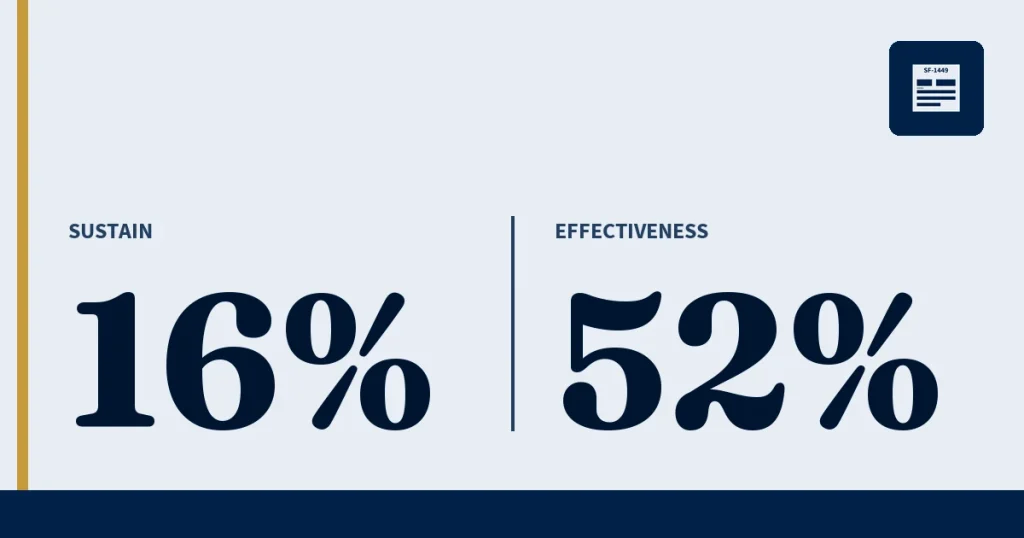
This pattern shows up clearly in bid protest data. The U.S. Government Accountability Office (GAO) handled 1,803 bid protest cases in fiscal year 2024 and found an overall effectiveness rate of 52 percent. That figure measures how often the protesting contractor got some form of relief, including corrective action by the agency (GAO FY2024 Bid Protest Annual Report, GAO-25-900611). Corrective action most often means the agency had to go back and fix its process. Process failures, not capability gaps, drive a significant share of contract disputes from the very beginning.
Industry observers have documented the same pattern from the contractor side. Small businesses frequently lose not because a larger firm did better work, but because the larger firm had a dedicated proposal team that knew how to follow instructions precisely and frame its experience in the language the evaluators use.
Experience compounds that advantage over time. New entrants to federal contracting submit proposals while still learning the rules of the game. The fix is not to wait until you have more experience. The fix is to learn the three rules that matter most, right now.
Failure #1: The Section L Compliance Trap
Section L of a federal RFP contains the exact rules for how your proposal must be formatted and submitted. Evaluators use Section M (the Evaluation Factors section) to score proposals. But contracting officers use Section L to determine which proposals are even eligible to be scored.
The L-trap is simple: contractors read the technical sections carefully and skim the instructions. A single missed requirement, such as a page count violation, a missing volume, or a signature on the wrong form, is enough to make the proposal non-responsive. Non-responsive proposals are rejected without evaluation.
The 10 Most Common Section L Violations
- Page limit overruns. If Section L says the technical volume cannot exceed 25 pages and you submit 27, the contracting officer can reject the submission or request you truncate it. Either outcome hurts.
- Font and margin violations. Many RFPs specify minimum font size (typically 12-point) and margin width (typically one inch). These exist so agencies can compare proposals fairly. Compressing type to fit more content is a common mistake.
- Missing required certifications. RFPs frequently require certifications (SAM.gov active registration, certifications of independent price determination, cybersecurity representations). A missing certification is a compliance failure even if the underlying condition is true.
- Wrong volume structure. Some RFPs require separate volumes (technical, management, past performance, price) submitted as distinct files. Combining volumes or submitting a single document when separate files are required can disqualify the proposal.
- Missing Key Personnel resumes. If Section L requires resumes for named positions, those positions must appear in the proposal with resumes that meet the specified format and length.
- Failure to address all tasks in the Statement of Work (SOW). Every task in the SOW should be acknowledged and addressed. Gaps signal the contractor did not read the full document.
- Submitting to the wrong address or portal. Electronic submissions (SAM.gov, email, agency portals) have specific submission paths. Wrong portal submissions may be disqualified as late or non-compliant.
- Missing subcontractor information. RFPs that require teaming or subcontracting plans will specify exactly what information each subcontractor must provide. Missing subcontractor data is a common error on team submissions.
- Expired registrations. An expired SAM.gov registration at time of award (or sometimes at time of submission) makes the contractor ineligible. Many new contractors register once and forget to renew annually.
- Incorrect pricing structure. If Section B (the pricing schedule) specifies line item numbers, labor categories, and quantities, your price must follow that structure exactly. Submitting a price that does not match the required format creates ambiguity that agencies routinely resolve against the contractor.
How to Build a Compliance Matrix (About 30 Minutes)
A compliance matrix is a simple table that maps every instruction in Section L to the corresponding section of your proposal. It takes about 30 minutes to build for a mid-size RFP and longer for complex multi-volume solicitations. It eliminates most compliance failures before they happen.
Open a spreadsheet. Create four columns: Section L Reference, Requirement, Proposal Location, Compliant (Y/N). Read Section L from top to bottom. Every time you find an instruction (page limit, format requirement, required section, required form) add a row. Fill in the proposal location where you addressed it and mark Y or N. At the end, every N is a compliance gap you must fix before submission.
Run this matrix twice: once after your first draft, and again in the 48 hours before submission. Proposals change during revision. Sections get cut, reorganized, or reformatted. A requirement that was compliant in draft one may no longer be compliant after editing.
Failure #2: Treating Past Performance as Boilerplate
Section M of a federal RFP lists the evaluation factors and their relative weights. These are the criteria evaluators use to score your proposal. Per FAR 15.304(c)(3)(i), past performance is a required consideration for most competitive acquisitions above the simplified acquisition threshold (FAR 15.304).
In practice, past performance often carries 25-40 percent of the evaluation weight on competitive acquisitions, though the specific weight is set agency-by-agency in Section M of each solicitation. There is no FAR mandate that prescribes a fixed range. Yet most first-time contractors treat past performance as an afterthought: a paragraph listing projects they have done, with dates, dollar values, and a point of contact. That format tells the evaluator what you did. It does not tell the evaluator whether what you did is relevant to this contract.
Write Past Performance Against Section M, Not Section L
Evaluators score past performance against the factors listed in Section M. If Section M says the agency will evaluate past performance based on “technical quality of deliverables,” “on-time performance,” and “customer satisfaction,” those are the three dimensions your past performance writeups must address. Not what the project was. Not how large it was. How you performed on those three specific dimensions.
For each past performance entry, use this structure:
- Contract reference: Contract number, agency, period of performance, dollar value.
- Relevance statement: One to two sentences connecting this project to the scope of the current RFP. Use the language from the Statement of Work.
- Performance narrative: For each Section M past-performance evaluation factor, provide a specific example. Not “we delivered quality work.” Provide: “We delivered all 12 monthly data reports on time, with zero revisions requested, and received a rating of Exceptional on the CPARS (Contractor Performance Assessment Reporting System) evaluation.”
- Point of contact: Full name, title, phone, email. The government will call. Make it easy.
Using Commercial Work as Federal Past Performance
New federal contractors often assume their commercial work does not count. It does. FAR 15.305(a)(2)(ii) explicitly allows agencies to consider relevant commercial past performance when evaluating offerors with limited federal experience (FAR 15.305).
The key is framing. A commercial IT services project for a regional bank does not read as federal past performance until you translate it. “Managed a 14-month network infrastructure project for a regulated financial institution, delivering all milestones on schedule with zero security incidents, under contract terms requiring monthly status reporting and defined SLAs.” That framing maps directly to typical Section M factors: technical quality, schedule adherence, customer satisfaction, and risk management.
Pull your three strongest commercial projects. For each one, read the Section M evaluation factors and write one sentence connecting the commercial project to each factor. That exercise alone will separate your past performance section from 80 percent of the first-time submissions the government sees.
For a deeper look at building past performance when you are starting from zero, see our guide: Past Performance for New Contractors: How to Build It When You Have None.
Failure #3: The Wrap-Rate Math Error
A wrap rate is the multiplier that converts a contractor’s direct labor cost into a fully burdened billing rate. The fully burdened rate is the total hourly cost the government pays, including the contractor’s fringe benefits, overhead, and general and administrative (G&A) expenses. The wrap rate math error is the single most common pricing mistake first-time federal contractors make, and it is purely mechanical.
Most contractors add their indirect rates together. That is wrong. Indirect rates must be cascaded, meaning each rate is applied to a progressively larger base.
The Cascade Calculation: A Worked Example
Assume the following indirect rate structure:
- Base labor rate: $1.00 per hour (used here for illustration; apply this math to your actual labor rate)
- Fringe rate: 30% (applied to direct labor)
- Overhead rate: 40% (applied to direct labor plus fringe)
- G&A rate: 10% (applied to total cost, including overhead)
Cascade method (correct):
| Step | Calculation | Result |
|---|---|---|
| Base labor | $1.00 | $1.00 |
| + Fringe (30%) | $1.00 x 1.30 | $1.30 |
| + Overhead (40%) | $1.30 x 1.40 | $1.82 |
| + G&A (10%) | $1.82 x 1.10 | $2.00 |
Correct wrap rate: 2.00x (meaning the fully burdened rate is $2.00 for every $1.00 of direct labor).
Addition method (wrong):
1 + 0.30 + 0.40 + 0.10 = 1.80x
The gap: 1.80x versus 2.00x is a 10 percent understatement. On a $500,000 contract, that is $50,000 in unbilled costs. If you win at the lower price, you absorb those costs out of margin. If the government compares your bid to a competitor who calculated correctly, your price looks artificially low, which can trigger a realism concern during evaluation. Worse, it can lock you into a loss-making contract.
The cascade principle is documented consistently across government contracting pricing references, including industry guidance from Deltek (Deltek Wrap Rate Guide) and federal acquisition pricing training material from the Defense Acquisition University.
For the full step-by-step calculation guide including how to set your rates by labor category, see: Wrap Rate Calculation for Government Contractors. If you want to understand how indirect cost rates are structured before you build your wrap rate, start with: Indirect Cost Rates for Government Contractors: A Plain-Language Guide.
The 90-Minute Pre-Submit Audit
These three checks can be completed in 90 minutes on any proposal before you submit. Build them into your process on every bid, not just the ones that feel important.
Block 1: Compliance Check (25 minutes)
- Open Section L and your compliance matrix side by side.
- Confirm every Section L instruction has a corresponding proposal section marked compliant.
- Verify page counts for each volume against the limits in Section L. Count the pages yourself; do not trust your word processor’s page counter on proposals with tables and graphics.
- Confirm the font size and margins on the final PDF. Open the PDF, zoom to 100%, and check that body text is readable at the specified minimum size.
- Verify your SAM.gov registration is active and will remain active through the anticipated period of performance. Log in and check the expiration date.
- Confirm all required certifications and representations are signed and dated.
- Check the submission instructions one more time. Confirm the submission portal, the correct email address (if applicable), and the deadline including the time zone.
Block 2: Past Performance Review (35 minutes)
- Open Section M. List every past-performance evaluation subfactor the agency will score.
- For each past performance entry in your proposal, check that each Section M subfactor is addressed with a specific example, not a general claim.
- Confirm every point of contact is current. Call or email each one before submission if you have time. A disconnected phone number on a reference looks careless.
- Verify the dollar values and dates are accurate. These can be cross-checked and an error signals sloppiness to an evaluator.
- If you have used commercial work as past performance, confirm you have connected each example to the RFP scope using language from the Statement of Work.
Block 3: Pricing Math (30 minutes)
- Pull your indirect rate structure and verify you are cascading, not adding. Run the full cascade calculation from your base labor rate to your fully burdened billing rate.
- Check each labor category in your price schedule. Confirm the burdened rate for each category is derived from the cascade, not a shortcut estimate.
- Verify that the total evaluated price in your proposal matches the price schedule exactly. Rounding errors between schedules and narrative sections are more common than most contractors expect.
- Confirm fee or profit is applied at the correct point in your cost buildup per the contract type. Cost-plus contracts apply fee differently than fixed-price contracts.
- Have someone else check the arithmetic on at least three labor categories. Eyes that did not build the model catch errors that the builder skips.
What to Do After You Lose
Request a debrief. Under FAR 15.506(a)(1), the contractor must submit the written debrief request within 3 days after receiving notification of contract award. Three days is the rule. Day four is too late. Mark the clock the moment you receive the award notification. Email is faster and timestamped; do not rely on mail.
Agencies must provide debriefs for competitive acquisitions above the simplified acquisition threshold when the request is timely. Oral or written debriefs are typical. Most agencies will tell you which evaluation factors your proposal performed weakly on and where the awardee outperformed you.
Ask specifically: Was the proposal compliant? How did our past performance compare to the awardee’s? Were there any concerns with our price? Those three questions map directly to the three failure modes in this article. The answers tell you where to invest before the next bid.
The debrief also matters for protest timing. If you decide to file a bid protest at GAO, the timing rules treat a required debriefing as a separate event that affects both your GAO timeliness window (4 CFR 21.2(a)(2)) and your CICA automatic stay timing (31 U.S.C. 3553(d)(4)(A)). For the rules, see our companion guide: Bid Protest Sustain Rate vs. Effectiveness Rate: 16% vs. 52%.
One loss is data. Use it. The contractors who win consistently are not smarter. They are more systematic.
For next steps on building a stronger proposal from the start, read: How to Write a Government Contract Proposal and How to Read an RFP: A First-Timer’s Guide to Government Solicitations.
Frequently Asked Questions
What is Section L of an RFP and why does it matter so much?
Section L stands for Instructions, Conditions, and Notices to Offerors. It is part of the Uniform Contract Format defined at FAR 15.204-5(b) and contains the specific formatting and submission rules for your proposal: page limits, font requirements, volume structure, required forms, and submission deadlines. Contracting officers use Section L to determine which proposals are eligible for evaluation. A proposal that violates Section L requirements can be disqualified before any evaluator reads the technical content, regardless of how strong the underlying work is.
Can I use commercial projects for past performance on a federal proposal?
Yes. FAR 15.305(a)(2)(ii) explicitly allows agencies to consider relevant commercial work as past performance, particularly for new entrants to federal contracting. The key is framing: your commercial work must be written against the specific evaluation factors in Section M of the RFP. A commercial project described in generic terms will not score well. The same project described through the lens of the agency’s specific evaluation criteria can be highly competitive.
What is a wrap rate and how do I calculate it correctly?
A wrap rate is the multiplier that converts your direct labor cost into a fully burdened billing rate. Calculate it by cascading your indirect rates, not adding them. The correct math: multiply your base labor by (1 + fringe rate), then multiply that result by (1 + overhead rate), then multiply that result by (1 + G&A rate). Adding the percentages together understates the true rate by approximately 10 percent, which can cost you money on every contract you win.
How do I request a debrief after losing a federal contract?
Submit a written debrief request to the contracting officer within 3 days after you receive notification of contract award, per FAR 15.506(a)(1). State that you are requesting a debriefing per FAR 15.506. Agencies must offer a debrief for competitive acquisitions above the simplified acquisition threshold when the request is timely. Under FAR 15.506(a)(4), untimely debriefing requests may be accommodated at the contracting officer’s discretion, but accommodation is not required. Do not assume a late request will be granted. Ask specifically about your proposal’s compliance, past-performance evaluation, and pricing assessment. That information shapes your next bid.
Is a compliance matrix really necessary, or is it just extra work?
A compliance matrix is the fastest way to find a disqualifying gap before the contracting officer finds it for you. It takes about 30 minutes on a standard RFP and forces you to read Section L instruction by instruction rather than skim it. Most contractors who skip the matrix believe their proposals are compliant. The debrief often tells a different story. Treat it as required, not optional.
What is the difference between Section L and Section M?
Section L tells you how to write and submit your proposal (formatting rules, required sections, submission instructions). Section M tells you how the government will score your proposal (evaluation factors, subfactors, and their relative importance). Both sections live in the FAR Uniform Contract Format: Section L at FAR 15.204-5(b) and Section M at FAR 15.204-5(c). Your proposal must comply with Section L to be eligible for evaluation, and it must be written to Section M to score well. Most first-time contractors focus too much on Section L compliance and not enough on writing the technical and past-performance volumes against Section M’s specific criteria.
How long should past performance narratives be in a federal proposal?
Follow Section L’s page limits for the past performance volume. Within those limits, aim for one concise page per project: contract reference details, a one-to-two sentence relevance statement connecting it to the current RFP scope, specific performance examples for each Section M evaluation subfactor, and a current point of contact. Quality of connection to Section M factors matters far more than length. A half-page entry that directly addresses every evaluation subfactor outperforms a two-page entry that describes the project without connecting it to the evaluation criteria.